
ETF
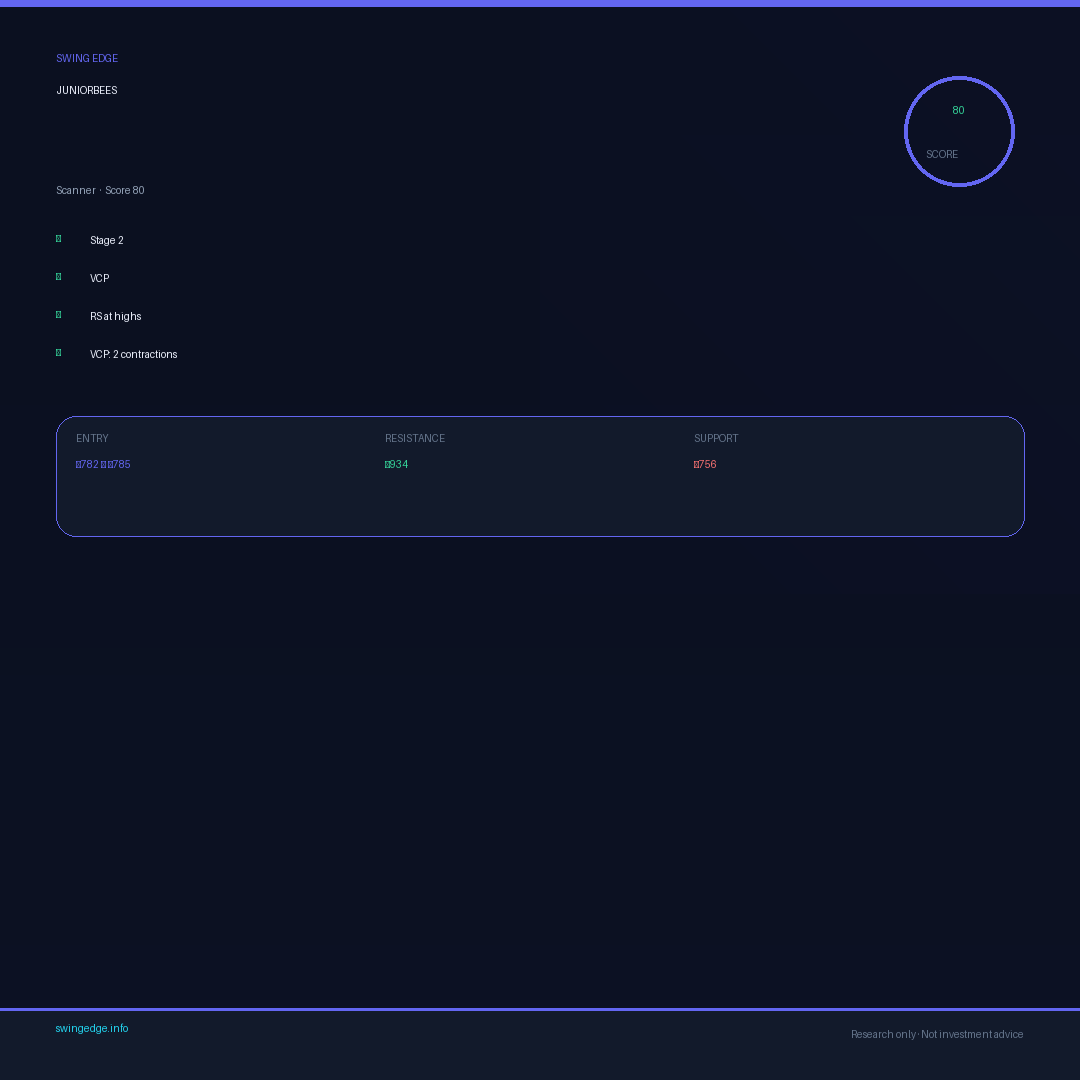
JUNIORBEES
Nippon India ETF Nifty Next 50 Junior BeES
Watchlist-worthy setup
Setup readiness
Early Trend
- Entry Zone
- ₹781.8-784.8
- Support Level
- ₹755.6
- Resistance
- ₹934.5
- Risk / Reward
- 5.2 : 1
- Risk Distance
- 3.7% to stop
Reference levels for educational study only. Not a recommendation to buy or sell.
Swing Edge Intelligence
Structured setup analysis · research only
Setup status · Constructive setup
Structure shows workable momentum characteristics with selective risks to monitor.
Bullish factors
- Early breakout leg underway — monitor extension versus pivot.
- 2 prior pivot rejections in last 60d (-16 pts).
- 5 closes within 1.3% — tight band forming.
- MACD positive and rising — confirmation only (no bonus).
- RSI 61 — ideal setup zone.
- Flat Base (6.0pts) — institutions holding tightly, no distribution.
- OBV divergence — price flat, volume rising: hidden strength.
- Volume flow suggests quiet institutional accumulation.
Risk factors
- 4 distribution days recently — institutional selling
- Price up but OBV diverging — demand weakening
Why not 100?
- RS rank is below elite leadership band (<90)
- Volume quality is not in top confirmation range yet
Overall view
Constructive setup — key momentum and institutional cues are broadly aligned for continued research.
Trade management framework
Research framework only. Use your own risk controls.
- If price moves +1R, consider reducing downside by moving stop closer to entry.
- If price reaches around +1.5R to +2R, consider partial profit booking (for example 20-30%).
- If trend extends beyond +2R, consider trailing below a fast trend reference (for example 21 EMA).
Setup research
JUNIORBEES — trend, RS & risk snapshot (not a trade recommendation)
Signal · context · invalidation · risk · skip reasons — research only
Why now
Coiled at the pivot — breakout trigger is imminent
- RS line at new highs — leadership intact
- Confirmed Stage 2 uptrend
Context & regime
- Market regime Mixed / range-bound
- Trend stage Stage 2 — tradable
- Sector Lagging (#29/30) — headwind
- Relative strength Lagging (RS 57)
- Trend strength Weak (ADX 13)
What invalidates it
This idea is wrong below ₹755.6 (3.3% away)
Base / stop support breaks — the swing thesis is wrong below here
- Stop / base low₹755.6
- Pivot — failure re-entry below₹780.9
Risk distance
Risk ≈ ₹29.16/share from entry ₹784.8.
Reasons to skip 2
Disqualifiers that apply even if the score looks good.
- 4 distribution days recently — institutional selling
- Price up but OBV diverging — demand weakening
JUNIORBEES Support & Resistance Levels
Research chart
Daily price action with entry, stop, and target levels from our latest scan, plus relative strength vs Nifty.
Entry zone, stop and targets are drawn on the price chart. · Research only.
Sector RS rank · latest scan
Loading peer comparison…
Trader brief
What to understand
JUNIORBEES Entry, Stop-Loss & Targets
Research heuristic · not a buy/sell call
Solid scanner setup worth tracking. The main question is timing: confirm the base is still tightening and relative strength is not rolling over before sizing risk.
AI insights
AI Insights
Generated with AIThese insights are AI-generated to support your research process and should not be treated as investment advice or a recommendation to buy or sell securities.
Sign in to unlock AI Insights
Personalised swing trade analysis powered by Gemini AI
Pattern context 52w · setup · flow
52-week range
—Stage-2 ideal band · Early recovery
Setup highlights
Pattern signals from the latest scan
Smart money flow
Last 60 sessions · accumulation vs distribution
Setup intelligence Overhead · VCP · radar · risk
Overhead supply
Resistance ceiling above current price
Chase / failure risk
Honest read on exhaustion & extended moves
Base / VCP coil
Depth, contractions & pivot distance
Setup quality radar
Shape of the setup in one view
Setup metrics Strong
JUNIORBEES Technical Analysis & Swing Setup
Grouped structure, momentum and risk from the latest research scan.
Structure
Momentum
Risk
More scanner fields
Peer comparison Sector peers
Sector Peer Comparison
Loading sector peers…
JUNIORBEES FAQ Common swing-trading questions
Frequently asked questions about JUNIORBEES
Is JUNIORBEES a good swing trade right now?
On Swing Edge's swing-setup framework, Nippon India ETF Nifty Next 50 Junior BeES (JUNIORBEES) currently grades C — mixed — needs patience. Coiled at the pivot — breakout trigger is imminent. Flagged today. This is educational research, not investment advice.
What are JUNIORBEES's support and resistance levels?
For JUNIORBEES, near-term support sits around ₹755.6 (the base/stop zone); overhead resistance is around ₹780.9 (the breakout pivot); the next resistance above is ₹934.5. This is educational research, not investment advice.
What is the breakout / pivot level for JUNIORBEES?
The breakout pivot for JUNIORBEES is around ₹780.9. Price is currently about 0.0% above the pivot. A breakout is typically confirmed on a close above the pivot with above-average volume. This is educational research, not investment advice.
Is JUNIORBEES above its 50-day and 200-day moving averages?
Yes — JUNIORBEES is in a confirmed Stage 2 uptrend, trading above its rising 50- and 200-day moving averages, the zone where swing setups tend to work best. This is educational research, not investment advice.
How strong is JUNIORBEES versus the market (RS rank)?
JUNIORBEES has a relative strength (RS) rank of 57 out of 100 versus the NSE universe, making it lagging the broader market on relative strength. Trend strength (ADX) reads 13, indicating a weak/choppy trend. This is educational research, not investment advice.
What are the entry, stop-loss and target levels for JUNIORBEES?
Reference swing levels for JUNIORBEES: entry around ₹784.8, stop-loss around ₹755.6, targets at ₹934.5 and ₹937.1. That works out to roughly a 5.2:1 reward-to-risk on the first target. These are reference levels for study only — this is educational research, not investment advice.
Answers are generated from Swing Edge's latest scan data and are for research only — not investment advice.
Prices and day-change figures use the last daily close from scan data dated 2026-06-19 — not live intraday NSE quotes.