
Continuation energy: flags, VCPs, and tight bases
How swing traders interpret high-tight flags, volatility contraction, and coiled ranges—with failure modes.
~36 min read
These names come from momentum and stage-style literature (O'Neil, Weinstein, Minervini, others). They are shorthand for chart geometry and participation, not proprietary signals. Your job is always the same: tie the pattern to liquidity, invalidation, broader trend, and gap risk before you size.
High tight flag (HTF)
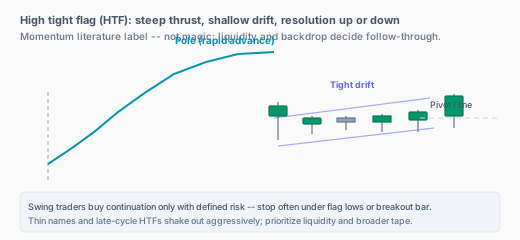
A high tight flag sketches a very strong advance (the “pole”) followed by a comparatively shallow, short digestion that drifts sideways or slightly down—not a deep 50% retracement. Continuation traders look for initiative to resume before the structure breaks down. It is common in strong leaders after news or repricing; it also appears in thin names that spike and mean-revert brutally if the tape turns.
- Check float, average daily value, and auction quality: wide spreads and gaps make the same line far riskier.
- Prefer a clean pivot for stop placement (flag low, prior swing, or breakout bar) rather than a fuzzy “area.”
- HTF late in a sector move or after a parabolic month is a different base rate than HTF early in markup—context first.
- Downside breaks of a tight flag can accelerate; do not assume symmetry with the long case.
Volatility contraction pattern (VCP-style)
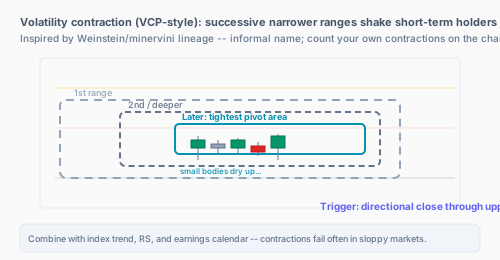
A VCP informal description is a base with successive volatility contractions—each shakeout narrower than the prior, often with lower peaks and higher lows scraping into an apex area. Sellers become less willing to dump at lows; incremental supply is worked off. Automated scanners loosely approximate “VCP-ness” with pivots and ATR tightening; charts still need human judgment.
- Count contractions on your timeframe (daily vs 4h)—rules are heuristic, not universal counts.
- Volume often fades into the pinch and expands again on resolution; absent expansion, treat breakouts skeptically.
- False breaks remain common inside ranges; combine with RS vs Nifty/BSE index and sector strength.
- Earnings, rights, dividends, macro prints: events can negate a pretty contraction overnight.
Tight range contraction and sideways drift
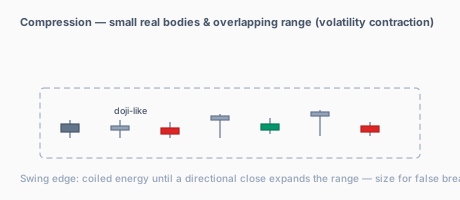
Not every powerful setup needs a flashy name. Tight sideways ranges—small real bodies, overlapping highs and lows, shrinking daily ranges—signal a balance between buyers and sellers. Edge comes from anticipating which side will lose patience after the contraction, then trading the break/reclaim with documented risk.
Neighboring ideas swing traders reuse
- Cup-with-handle archetype (rounded base plus handle drift): liquidity and overhead supply dictate success more than curvature.
- Flat base resting on rising long-term averages vs deep V-reversal bases—different aggression and fade risk.
- Ascending bases (higher pullback lows inside a wedge or channel)—can prelude resolution up if supply does not avalanche.
- Pullback to the 50-day or RS anchor is not a licensed entry; verify structure and liquidity on each name.
Operational checklist
- State bullish vs bearish resolution criteria before clicking—what print invalidates?
- Map index correlation: contraction breakouts dying with the benchmark is frequent in risk-off rotations.
- Journal whether your edge came from breakout, pullback, or mean reversion; pattern labels should trace to logs.
- When two patterns overlap (HTF atop a VCP), simplify to one thesis and one stop story—avoid stacking narratives.