
Trade with the tide
Stage analysis and trend structure help you avoid fighting the dominant forces.
~30 min read
Price rarely trends in a straight line. A common mental model is a four-phase cycle: basing (range-bound, often called accumulation in older literature), markup (uptrend), distribution (topping range), and markdown (downtrend). Not every stock tags every phase cleanly, but the framework helps you ask: are we late in a move or early after a reset?
On the long side, swing traders usually prefer markup or the early transition from base to markup: when evidence suggests demand is in control and sellers are less willing to press offers at prior resistance. Buying deep markdown without a reversal plan is a different game—valid for some, but not the default swing template.
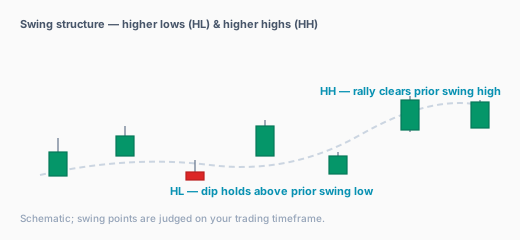
Higher highs and higher lows (uptrend structure)
An uptrend can be described as a sequence of rising swing lows and rising swing highs. Each pullback that holds above the prior swing low is evidence buyers are paying up on dips. A break of a meaningful swing low does not guarantee ruin, but it should downgrade your bullish bias until structure repairs.
- Mark swing points on the chart you actually trade (daily vs 4h) so structure arguments are not moved after the fact.
- The first pullback after a credible breakout often offers a more objective stop than chasing the breakout candle.
- Failed breakdowns—price pierces support intraday or for a day, then reclaims—can precede sharp squeezes; treat them as context, not automatic entries.
- Lower highs and lower highs in a row are the mirror pattern for bearish structure; long-biased swing traders often stand aside until repair.
Market, sector, and correlation
A stock can have a perfect pattern and still fail if the index or its sector rolls over. Correlation is not constant—some names lead and some lag—but on risk-off days liquidity often punishes everything at once. Checking Nifty or relevant sector ETFs is not superstition; it is a cheap filter.
Relative strength (RS) concepts try to answer: is this name holding up better than its benchmark on down days and participating on up days? Tools like Swing Edge surface RS-style context; use it to narrow a list, not to skip your own chart read.
False breaks and whipsaw
Not every close through resistance is a durable breakout. Low-volume pushes, obvious bull traps into known supply, and one-day spikes can reverse quickly. Many traders require confirmation: follow-through days, retest holds, or constructive volume—not a single thin candle.
- If your thesis was solely “it crossed a line,” you will be hurt often; add a second factor (volume, structure of the base, group strength).
- Whipsaw clusters often appear when the broader market is range-bound; reduce size or trade fewer names.
- Document false breaks you took; patterns repeat and your journal will show which filters actually help you.
How this ties to screening
Pre-breakout and stage-style screens highlight compression and potential energy. They do not replace context: you still decide if the broader tape supports long risk, whether liquidity in the stock is acceptable, and whether your stop and target story make sense. Think of scanners as interns that fetch candidates—you still interview each chart.