
Top-down: weekly sets bias, daily sets setup, intraday sets trigger
Most swing-trade losses come from one timeframe disagreeing with another. MTF analysis catches that conflict before you enter.
~32 min read
Every chart you look at is one slice of a larger picture. A daily breakout on a stock that's weekly-rolling-over has a completely different base rate than a daily breakout on a stock that's weekly-coiling-up. The chart pattern is the same. The follow-through probability is not. Multi-timeframe (MTF) analysis is the discipline of reading at least two timeframes before committing capital — and ideally three.
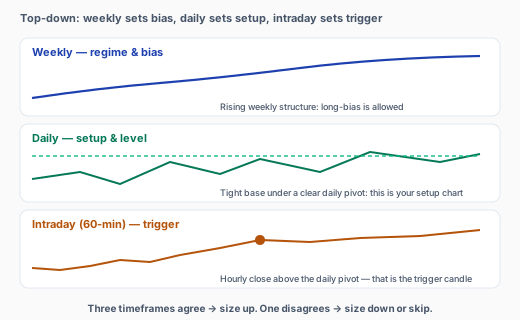
The three-timeframe template
- Weekly — regime and bias. Is the long-term trend up, down, or sideways? Is the weekly RSI above or below its midline? Is the weekly MACD positive?
- Daily — setup and structural level. What's the base shape? Where's the pivot? Are the daily moving averages stacked? Where's the invalidation?
- Intraday (60-min or 15-min) — trigger and timing. When does the actual breakout happen? Is volume confirming?
Why one timeframe lies
A daily chart by itself can look bullish while a weekly chart shows a clear topping pattern that's about to break. The daily breakout might happen — even close strong — and still be the high of the move because the weekly is dictating the bigger picture. Conversely, a daily that looks weak might be a normal pullback inside a strong weekly uptrend, and the right trade is to buy it, not avoid it.
Alignment rules of thumb
- All three timeframes agree → high-quality setup. Size up (within your risk plan).
- Weekly and daily agree, intraday is muddy → still tradeable but use intraday for trigger only, not for thesis.
- Weekly and daily disagree → skip or size very small. You're fighting one of them no matter which way you trade.
- Daily setup looks great but weekly is rolling over → this is the most common trap. Pretty daily charts in deteriorating weekly tapes fail repeatedly.
Weekly chart reads
Weekly bias is set by: position relative to the weekly 30-week MA (or 50-week SMA), slope of that average, weekly higher highs and higher lows, weekly RSI above/below 50, weekly MACD position relative to zero. You don't need all of these to agree, but you want most to point the same way before calling the weekly trend bullish or bearish.
Daily chart reads
On the daily, you're looking for the setup: tight base, clear pivot, defined risk, confluence with the 20 or 50 EMA. The daily is where you make most of your decisions — but only after weekly tells you whether you should be hunting longs, shorts, or sitting out entirely.
Intraday chart for execution
60-min charts are the swing trader's intraday workhorse. The 60-min close above the daily pivot is the most common high-quality trigger. 15-min charts are useful for very tight entries but can over-trigger on noise. Don't shop intraday timeframes looking for confirmation of a daily idea — that's called "timeframe shopping" and it kills accounts.
MTF for exits
MTF cuts both ways. Your trailing stop on a swing trade should respect the timeframe that produced the entry. A daily-entry swing trade shouldn't be exited on a 15-min wobble — that's reading your timeframe wrong on the way out. Use intraday for trigger management ("is the move continuing today?") and daily for stop trail ("is the swing structure intact?").
MTF pitfalls
- Timeframe shopping — flipping through 5, 15, 60, daily, weekly until you find one that confirms what you already wanted to do.
- Using too many timeframes — five charts of the same stock at different intervals is noise. Three is the sweet spot.
- Mismatch between entry and exit timeframe — a daily-setup trade managed on 5-min charts gets stopped out on normal intraday wiggle.
- Forgetting the index. Even with perfect MTF on the stock, an index breakdown can override individual setups overnight.