
Bollinger Bands: volatility framing, squeeze setups, and band walks
Bands measure volatility, not direction. Use them for setup quality (squeeze) and trend continuation (band walk).
~26 min read
Bollinger Bands wrap a 20-period simple moving average with bands placed 2 standard deviations above and below. Statistically, roughly 95% of price action sits inside the bands. That's the framing — but the useful part isn't "price hits the band, so reverse." The useful part is what happens to the bandwidth (the gap between upper and lower) and what happens when price stays pinned against one band.
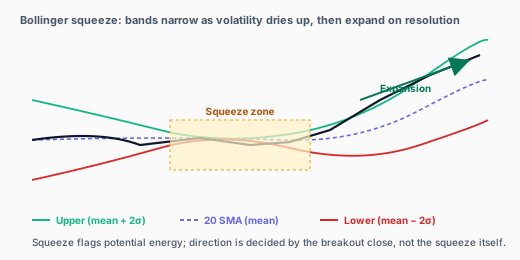
The Bollinger squeeze
When the upper and lower bands contract toward each other, bandwidth is at multi-month or multi-quarter lows. This is the squeeze: volatility has collapsed, and historically, periods of unusually low volatility precede periods of unusually high volatility. The squeeze does not predict direction. It predicts that something is coming. The actionable trade is the close beyond the bands when the squeeze resolves.
- Measure squeezes by Bollinger Bandwidth = (upper − lower) / middle. Six-month lows in bandwidth are the most powerful squeezes.
- Squeezes resolving in the direction of the larger trend have higher follow-through than counter-trend resolutions.
- False resolution is common: a single bar pierces the band and reverses. Wait for the close, not the wick.
- Combine squeeze with structure: a squeeze inside a tight base under resistance is a far better setup than a squeeze in chop.
Walking the band — continuation, not reversal
When a strong trend develops, price pins against the upper (or lower) band and walks along it — sometimes for weeks. This is the textbook moment where amateurs short the "overbought" name and lose. Band-walking is the highest-momentum tape; the trade is to be long with it, manage with a trailing stop, and only exit when price closes back inside the middle band on volume.
The middle band as dynamic mean
The 20 SMA at the center of the bands is the same line many traders use as the short-term mean. In trending tape, pullbacks to the middle band that hold and reverse are the lowest-risk continuation entries. Pullbacks that pierce the middle band and start using it as resistance are early signs of trend fatigue.
Bollinger %B and bandwidth as features
- Bollinger %B normalizes price within the bands (0 at lower band, 1 at upper). It's useful in scans — e.g., %B > 0.95 with rising bandwidth signals strong breakout potential.
- Bandwidth percentile tells you where current volatility sits historically. Below the 10th percentile is a textbook squeeze.
- Combining %B with regime (MACD position) and structure (recent base) outperforms using any of them alone.
Common Bollinger mistakes
- Selling at the upper band as "overbought" in trending stocks — band walks are continuation, not reversal.
- Treating every band touch as a mean-reversion signal — works in chop, fails in trend. Diagnose regime first.
- Ignoring bandwidth. Without checking volatility context, band touches alone are meaningless.
- Using default 20/2 in all markets. For thinly-traded names, longer periods reduce noise.