
MACD: trend confirmation, not crossover trading
The histogram is the most-watched part of MACD — and it tells you when momentum is accelerating or decaying before crosses fire.
~30 min read
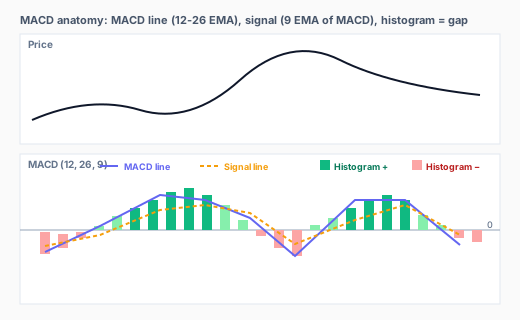
MACD (Moving Average Convergence Divergence) is built from three pieces: the MACD line itself (12 EMA minus 26 EMA), a signal line (9 EMA of the MACD line), and a histogram (the gap between MACD and signal). Most retail traders see crossovers and think "buy/sell." That's the worst use of the indicator. The histogram and the zero line are where the real information lives.
The zero line is the trend filter
MACD above zero means the 12 EMA is above the 26 EMA — short-term momentum is on top of intermediate. Below zero means the opposite. This single binary is the most useful piece of the indicator: long setups have higher follow-through when MACD is positive, short setups when MACD is negative. Trading bullish setups with MACD below zero is fighting the indicator's most basic signal.
Histogram acceleration & deceleration
A rising histogram (bars getting taller above zero) means MACD is pulling away from signal — momentum is accelerating up. A falling histogram (bars getting shorter) means MACD is converging toward signal — momentum is decaying, even if price is still rising. This is the leading edge of MACD: histogram deceleration almost always precedes price reversal.
- Histogram peaks before price peaks. Watch the bar heights — three consecutively shorter green bars after a run is a tightening-of-stops cue.
- Histogram troughs before price troughs. In bearish setups, three consecutively shallower red bars often precede the bounce.
- Color flips (green to red, red to green) are the crossover — they confirm what the histogram pattern already showed.
- Histogram is noisy on short timeframes — use it primarily on daily and weekly for swing decisions.
MACD divergence
MACD divergence works on the same logic as RSI divergence but with smoother data. Bullish: price lower low, MACD higher low. Bearish: price higher high, MACD lower high. Because MACD smooths more than RSI, its divergences are less frequent but typically more reliable — when MACD divergence and price structure agree, the signal quality is high.
Crossovers — when they matter
A bullish crossover (MACD crosses above signal) above the zero line is continuation in a healthy trend — useful for adding to winners or re-entering after a pullback. The same crossover below zero is a bounce in a downtrend — far less reliable, and most fail. The location of the crossover relative to zero changes the signal completely.
- Bullish cross above zero → high-quality continuation cue. Pair with price structure.
- Bullish cross below zero → counter-trend bounce. Lower win rate; use only with multiple confluence.
- Bearish cross above zero → pullback in an uptrend. Often a buying opportunity, not a short.
- Bearish cross below zero → continuation down. Pair with breakdown of structural support.
MACD on multiple timeframes
A common professional template: weekly MACD sets the regime (above/below zero determines long vs short bias), daily MACD sets the setup (histogram behavior and divergence), intraday MACD sets the trigger (crossover or histogram flip on the entry timeframe). When all three align, the trade is high-confidence. When weekly and daily disagree, sit out.
MACD pitfalls
- MACD is lagging by construction (averages of averages). Treat it as confirmation, never as a leading signal.
- Default 12/26/9 settings are fine for most stocks. Don't endlessly optimize parameters — you'll curve-fit history.
- MACD is meaningless in low-volume, range-bound stocks. The math assumes trend; without trend you get whipsaw.
- Stacking MACD + RSI + Stochastic + every other oscillator gives no extra information — they're all measuring momentum from different angles.