
Build every swing trade around R
A clean setup is incomplete until entry, invalidation, size, and exit rules fit together.
~38 min read
Swing traders usually lose money not because they cannot spot a good chart, but because they enter before the trade has a complete plan. A complete plan answers four questions before capital is exposed: where is entry, where is the idea wrong, how much account risk is allowed, and what will cause profit-taking or exit.
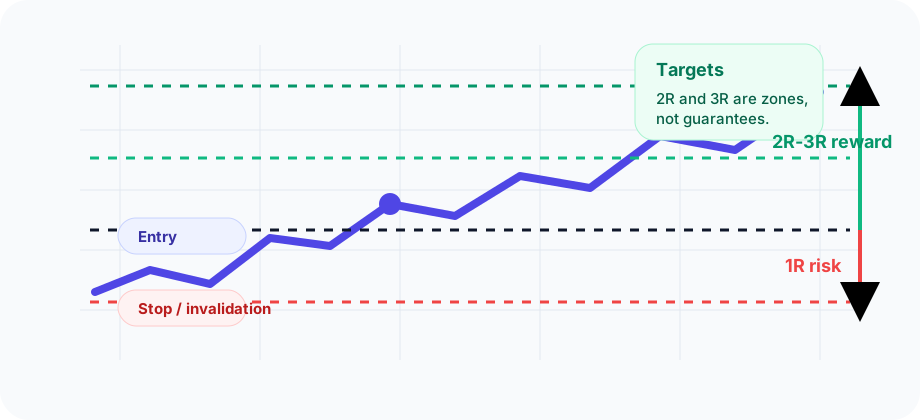
The five-line trade plan
- Setup: what pattern or scanner context surfaced the stock, and why is it interesting now?
- Entry trigger: the exact condition that activates the trade—breakout close, retest hold, reclaim, or planned pullback.
- Invalidation: the chart condition that proves the idea wrong, not just a convenient rupee loss.
- Position size: shares are calculated from account risk divided by per-share risk.
- Management: where you reduce, trail, hold, or exit if the trade does nothing.
Why R beats raw percentage talk
A 5% move can be huge or mediocre depending on the risk taken to earn it. If the initial risk was 2%, a 5% move is roughly 2.5R before costs. If the stop was 8% away, the same 5% move is not even 1R. Thinking in R prevents you from praising trades that only look good because the entry price was forgotten.
R also makes review honest across different stocks. A volatile pharma name, a bank stock, and a smallcap momentum leader cannot be compared purely by rupees or percent. They can be compared by whether the trade risked 1R and produced, lost, or protected multiples of that R.
Common plan failures
- Moving the stop lower after entry because the chart still looks interesting.
- Taking full profits too early because open profit feels fragile, then re-entering higher out of FOMO.
- Using the same share quantity for every stock even though stop distance and volatility differ.
- Skipping the trade plan for the strongest-looking chart—the exact chart where emotion is usually highest.
A practical template
Before entry, write: “I am interested because ____. I enter if ____. I am wrong below ____. I risk __R or ₹____. First management decision happens at ____.” If any blank is hard to fill, the setup is not ready.