
What is swing trading?
Hold positions for days or weeks—not minutes—and trade structure, not noise.
~28 min read
Swing trading sits between day trading and traditional investing. You are not trying to monetize every one-minute candle, and you are typically not buying with a ten-year-only mindset either. The goal is to hold through a phase of price discovery that may take several sessions to weeks, then exit or manage the position as the setup matures or fails.
That definition is operational, not academic. In practice, swing traders care about multi-day chart structure: swing highs and lows, congestion zones, breakout and pullback sequences, and how volume behaves around those transitions. The edge often comes from patience—waiting for a clean pattern and defined risk—rather than from speed of execution.
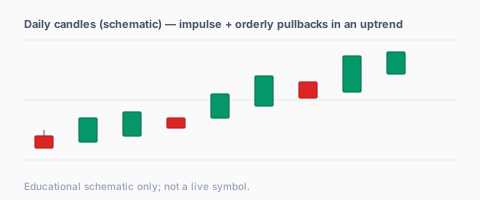
Daily candlesticks — OHLC in one session
Each daily candle encodes Open, High, Low, Close. The rectangular body spans open-to-close (green typically when close ≥ open on Indian charts); thin lines (‘wicks’ or shadows) extend to intraday extremes. Swing traders skim chains of candles to see imbalance: who defended which prices over multiple sessions.
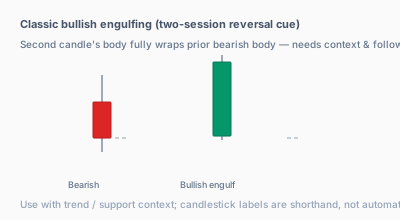
Single-candle ‘patterns’ (names from classical literature—engulfing, hammer, shooting star…) are mnemonic labels for imbalance at the close. Treat them as footnotes that must agree with swings, pivots, and your risk plan—not as buy/sell verdicts standing alone.
How swing differs from day trading
Day traders flatten before the close (or very soon after) and optimize for intraday patterns, order-book nuance, and rapid feedback loops. Capital turns over many times per week. Errors compound quickly, but so does learning if you review every session with discipline.
- Overnight gap risk: swing positions can open far from the prior close; earnings, macro prints, or sector news can gap you through a stop.
- Fewer decisions per day: you may check the book a few times rather than hundreds; that can reduce stress or increase boredom—both are risks.
- Broader noise tolerance: you accept wicks and mid-trend chop that a day trader might pay to avoid.
- Commissions and slippage matter less per trade in percentage terms when average hold is longer, but one bad gap can erase many small wins.
Swing vs longer-term investing
Long-term investors often anchor to business quality, valuation, and reinvestment. Swing traders still respect those factors but usually express the thesis in price structure: is the stock under accumulation, breaking out of a base, and holding relative strength versus its index? The holding period is tied to the chart job, not necessarily to the next annual report.
Nothing stops you from using both mental models. What hurts is mixing them without rules—e.g., turning a failed swing into an “investment” to avoid a loss, or scalping a long-term idea because of boredom.
Routine and review cadence
- Pre-market: scan your watchlist for gap risk, corporate actions, and whether key levels are still valid.
- Post-close: update journal, mark invalidation levels, and decide if tomorrow is a no-trade day based on news or mental state.
- Weekly: review win/loss not only in rupees but in process—did you follow entry, size, and exit rules?
- Monthly: step back for regime—trending vs choppy markets favor different setup types.
When swing style fits—and when it does not
Swing trading can fit people who have limited screen time during the session but can review charts daily. It fits less well if you cannot tolerate overnight uncertainty, if your capital is needed short-term, or if you lack a written risk plan. No style is morally superior; match style to psychology and schedule.
Pick one primary style as default. Mixing panic reactions from a day-trading mindset with overnight exposure from swing holds often produces churn: small wins, large emotional cuts, and inconsistent statistics.