
Anchored VWAP for context, pyramiding for size
AVWAP shows you who's in profit since a pivot. Pyramiding lets you scale into winners — without ever averaging into losers.
~28 min read
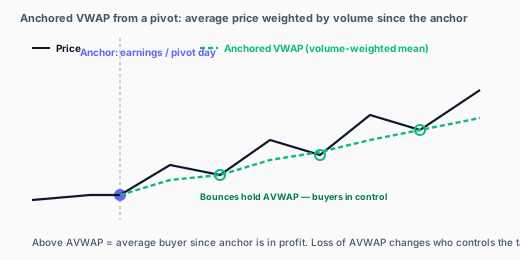
Most traders know VWAP (Volume Weighted Average Price) as the intraday line that resets each day. The far more powerful version for swing traders is Anchored VWAP (AVWAP) — VWAP started from a specific bar in the past: an earnings day, a major pivot low, a breakout day, a news event. AVWAP shows you the average price paid by every participant who traded since that anchor, weighted by their volume.
Where to anchor
- Last major swing low — shows who's in profit since the bottom of the current leg.
- Earnings or news day — shows whether reactive buyers are above water.
- Breakout bar — confirms that the average breakout buyer is still in profit (key for continuation theses).
- Top of a base before breakdown — for short setups, shows where trapped buyers are concentrated.
AVWAP as dynamic support and resistance
Price above a rising AVWAP means the average participant since the anchor is in profit — psychologically, no urgency to sell. Price below means the average participant is in loss — psychologically, every bounce attracts "get-me-out" supply. AVWAP is one of the cleanest dynamic levels you can plot on a chart because it has a direct behavioral interpretation, not just a mathematical one.
Multiple AVWAPs as confluence
A professional template: plot AVWAP from the prior earnings, AVWAP from the last major swing low, AVWAP from the 52-week high. Where two or three of these converge, you have a confluence zone — a level multiple cohorts of buyers are anchored to. Pullbacks into confluence zones tend to bounce; breakdowns through them tend to extend.
Pyramiding — scaling into winners
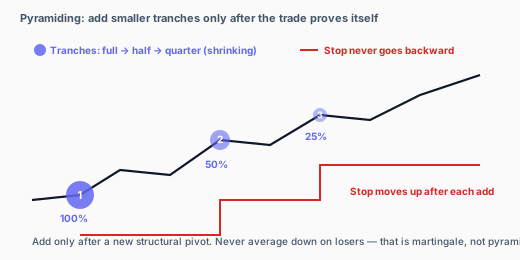
Pyramiding is the discipline of adding to winning trades — never to losing ones — using progressively smaller tranches. The first tranche is full size. The second is half. The third is a quarter. Each add only happens after the trade has produced a new structural pivot (new higher low for longs). The stop moves up with every add to protect blended cost.
Why smaller adds, not equal
Equal-size adds (100% + 100% + 100%) create a top-heavy position. If the last add was at a higher price and the trade reverses, your blended average moves up dramatically and your stop hits sooner. Progressively smaller adds keep the average cost closer to the original entry — preserving the asymmetry that made the trade attractive in the first place.
Pyramiding rules
- Add only after a new structural pivot — new higher low for longs, new lower high for shorts.
- Each add is smaller than the previous (1, 1/2, 1/4 is a common ladder).
- Move the stop on all units to below the new pivot after each add — never let the original stop linger.
- Cap total position size at a pre-defined R-equivalent — pyramiding can blow up account-level risk if uncapped.
- Never add at the entry level after a pullback — that's averaging down disguised as pyramiding.
Pyramiding vs averaging down
Pyramiding adds to winners. Averaging down adds to losers. Pyramiding is professional. Averaging down is the most common way retail accounts blow up. The asymmetry is in the math: pyramiding caps loss at the initial stop, lets the upside compound. Averaging down expands losses linearly with every add — and the trade you're "saving" was already wrong by definition (your invalidation has been violated).
Common pitfalls
- Adding too late in the move — the third pyramid at the top of a 10R run is exactly the wrong time. Pyramid early, not late.
- Stacking AVWAP confluence as the only thesis — AVWAP is context, not signal. You still need structure and a defined invalidation.
- Equal-sized adds — they make blended cost climb too fast and turn small reversals into stop-outs.
- Forgetting to roll the stop forward after each add — the trade then quietly grows past your account-level risk limit.