
Read volume with price, not alone
Breakouts need participation; pullbacks need supply to dry up.
~35 min read
Volume is often described as fuel, but that metaphor is incomplete. High volume can mark accumulation, distribution, panic, index rebalancing, or one-off news. The useful question is: how does volume behave at the exact price location that matters—near pivot, support, retest, or failure level?
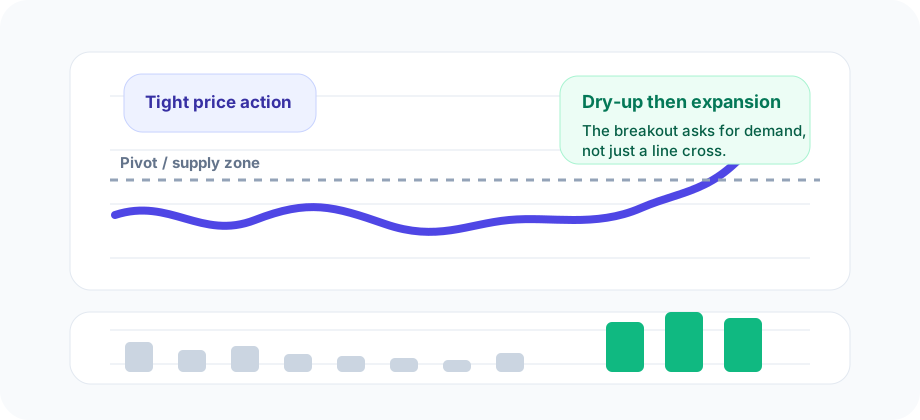
Volume dry-up before a move
In constructive bases, volume often contracts as the range tightens. That does not mean buyers vanished; it can mean sellers are less willing to hit bids lower. A dry-up near the top half of a base is different from a dry-up after a collapse, where lack of volume may simply mean lack of demand.
- Dry-up is strongest when price stays tight instead of leaking lower.
- Look for smaller real bodies and overlapping ranges; volume without range context can mislead.
- If volume dries up but relative strength also deteriorates, the stock may just be ignored.
Expansion on breakout
A breakout through a watched pivot asks for new demand. Higher range plus higher volume suggests buyers are accepting higher prices. Thin moves can still work, but their failure rate rises because there is less proof that institutions, funds, or serious participants supported the move.
Volume clues around failure
- Breakout above resistance on weak volume followed by a close back inside the base is a caution flag.
- Heavy volume down days after a breakout can indicate trapped buyers and forced exits.
- A retest that holds on quiet volume can be constructive; a retest that slices through on expansion is different.
- Avoid treating one high-volume day as permanent confirmation. Follow-through and holds matter.
How to use it in Swing Edge review
When a scanner surfaces a setup, check whether the story matches the volume row: drying volume inside the base, expansion on breakout, or suspicious expansion into selling. The scanner is the shortlist; volume-price reading is the quality check.