
Trailing exits: how to keep winners running without giving back the move
The hardest part of trading isn't the entry — it's deciding how to exit a winning trade. Mechanical trail systems remove most of the second-guessing.
~28 min read
Most retail traders take small profits and ride losers. The classic fix is mechanical trailing stops — pre-defined rules for moving your stop forward as price advances, never backward. The right trail depends on your timeframe and the stock's volatility, but the most important rule is the same everywhere: define the trail before you enter, and follow it.
Structural trails — swing low trail
The simplest trail: after a new swing high is made, move your stop to just below the most recent swing low. As the trend produces new higher highs and higher lows, the stop ratchets up. Loose enough to ride trends, structural enough to invalidate when the trend actually breaks. The drawback: requires you to recognize swing points, which is partly subjective.
Moving-average trails
- 20 EMA trail — tightest. Good for fast momentum trades. Will exit on most normal pullbacks.
- 50 EMA trail — medium. Standard for intermediate-term swing trades. Stays in through 5-10% pullbacks.
- 21 EMA on weekly — looser still. Survives normal swing-to-swing pullbacks, exits only on real trend changes.
- Close-based trails (exit on daily close below the MA) are far less whippy than touch-based trails (exit on any wick through).
ATR / Chandelier trails
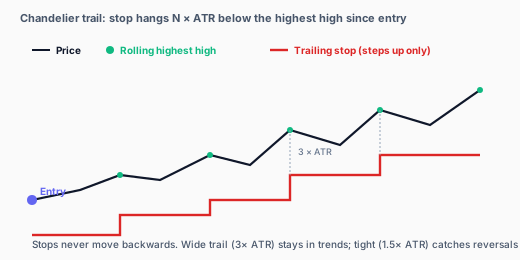
ATR-based ("chandelier") trails are mechanical and volatility-adjusted. Set at 3× ATR below the highest high since entry, the trail loosens automatically when the stock is moving fast and tightens when it slows. This eliminates the manual debate about "should I move my stop?" — the math does it for you.
Parabolic SAR — when it works
Parabolic SAR (Stop And Reverse) is an old-school trailing stop indicator. It works reasonably well in clean trends — the dots step up as price runs, tighten as momentum slows. It fails badly in choppy markets, where it flips constantly. Use it only in confirmed trends (ADX > 25) or skip it for alternatives like the chandelier.
Supertrend as a trail
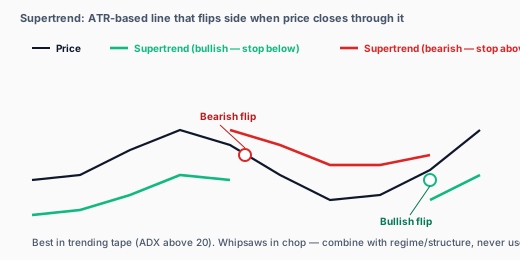
Supertrend is a popular ATR-based trail with a built-in flip on cross. Common settings are (10, 3) — 10-period ATR with 3× multiplier. The line flips from below to above price when the daily close breaks through, signaling regime change. It's smoother than parabolic SAR but still whips in chop.
Partial profits — scaling out
Trailing the entire position is psychologically hard. A common compromise: take partial profits at a defined R-multiple or structural target (e.g., 2R or prior swing high), then trail the remainder. This locks in some gain and reduces the pain of giving back open profit, at the cost of capping the trade's maximum reward.
- Take 1/3 at 2R, 1/3 at 4R, trail the final 1/3 — captures meat, leaves runway for the home run.
- Sell 1/2 at first resistance, trail the rest below the 50 EMA — common breakout-trader template.
- Take partial profits into climactic volume (one bar that's 3-4× average) — exhaustion is real and visible.
- Don't add to losers in a martingale way to 'average down.' If your invalidation hits, exit fully, then re-evaluate fresh.
Time stops
If your thesis was "resolution within two weeks" and the trade has done nothing for three weeks, the opportunity cost is real even if you haven't been stopped out. Time stops are mechanical and unpopular precisely because they force you to admit you were wrong about timing, not direction. They free up capital and attention for better setups.
Common trailing-exit mistakes
- Moving stops backwards. Once the trail is set, the only allowed direction is forward (up for longs, down for shorts).
- Tightening the trail mid-trade because you got nervous — that's the trade managing you, not the other way around.
- Using a trail mismatched to timeframe — daily-setup trades managed on 5-min trails get whipsawed for no reason.
- Mixing multiple trail systems. Pick one (structural, MA, ATR) per trade and stay consistent — switching mid-trade is panic, not strategy.