
Most traders polish entries and treat exits as afterthoughts. Institutional-grade retail process flips part of that: before entry you should know at least one scenario for taking profit and one scenario for tightening risk if the thesis extends. That does not predict the future—it prevents improvisation at emotional highs.
Anchoring targets to structure
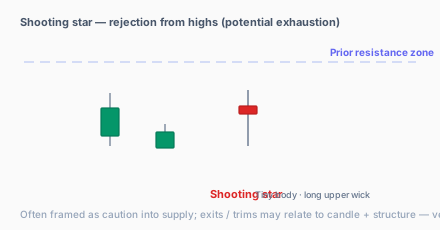
Chart-based targets often reference prior highs, measured moves (height of base projected from breakout), or zones where sellers historically reacted. Automated levels in tools illustrate model outputs; sanity-check them against liquidity and time—thin air above a gap can behave differently than a dense resistance band.
- Measured move math is heuristic, not physics—tape can truncate or overshoot drastically.
- Round psychological numbers sometimes matter purely because crowds watch them—not because of intrinsic valuation.
- Partial profits near major resistance reduce regret without forcing you out of entire trends.
Partial profits and trailing
Scaling out acknowledges uncertainty: you crystallize gain while leaving a smaller piece to capture runaway trends. Trails can follow swing lows below higher lows, shorter moving averages, or ATR multiples—each has trade-offs between giving back open profit and staying in the move.
- Tight trails catch reversals early but get shaken out in normal volatility.
- Loose trails stay in trends but give back open profit on sharp turns.
- Mixing both—part tight, part loose—can match different portions of the position to different goals.
Time-based and thesis-based exits
If your thesis was “resolution within two weeks” and price drifts sideways on falling volume, your capital may have better use elsewhere even if the stop is not hit. Time stops are underrated for opportunity cost.
Thesis breaks also matter: if the sector leader rolls over, or a key fundamental input you tracked changes, you may exit before a mechanical stop because the story you traded is no longer valid.
Gaps and event risk on exit day
- Earnings and policy events can gap through planned limits; consider reducing into the event if risk is undefined.
- India session gaps vs global ADR moves can open names away from your mental plan—predefine how you handle that.
- Emotional selling into a gap down often locks in the worst print of the month; a written rule helps.