
Moving averages: 20, 50, 200 — what each one actually tells you
Stop using moving averages as crossover triggers. Use them as regime, dynamic support, and slope filters.
~30 min read
A moving average is just an average of the last N closes, redrawn each day. That sounds boring, and the boring part is exactly why it is useful: it strips out single-candle noise and leaves a smoothed price track that the whole market watches. Two traders may disagree on a chart pattern, but the 50-day EMA is the same line on both their screens — and that shared reference is what makes it self-reinforcing.
Swing traders who treat moving averages as buy/sell triggers ("buy when price crosses the 50") usually lose money — the signals are late, lag every fast move, and whipsaw repeatedly in chop. The same averages used as regime filters, pullback magnets, and slope indicators are powerful. The difference is in how you frame them.
SMA vs EMA — which to use
Simple Moving Average (SMA) weighs every day equally. Exponential Moving Average (EMA) weighs recent days more — so it turns faster when price changes. For swing trading, most practitioners use EMAs for the 20 and 50 (because turns matter) and either SMA or EMA for the 200 (the slow line — they barely differ). Pick one convention and stay consistent so your charts read the same way every session.
The 20 EMA — short-term momentum
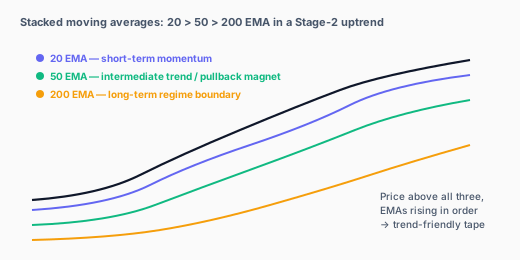
- Acts as the immediate trend rail. In strong moves, price hugs the 20 EMA and only briefly pierces it on pullbacks.
- Useful for swing trade management: a daily close back below the 20 EMA after a clean run is often the first signal to trim or trail tighter.
- Slope matters more than crosses. A rising 20 EMA that price is respecting is a green light; a flat or rolling 20 in a previously strong name is a yellow flag.
- Pullback entries to the 20 EMA in fast-moving leaders are a classic Minervini-style template — but only when the larger structure (50, 200) is also rising.
The 50 EMA — intermediate trend and pullback magnet
The 50 is the line most professional swing traders watch as the "line in the sand" for an intermediate trend. Stocks in healthy uptrends pull back to the 50 EMA cleanly, find buyers, and bounce. Stocks that break the 50 with conviction and start using it as resistance are usually transitioning to a different regime.
- Use the 50 EMA as a swing-stop reference for trend-followers: a weekly close below the rising 50 often means the swing thesis is broken.
- Distance from the 50 is a stretch indicator. If price is more than 7–10% above the 50 EMA on a stock that usually trades closer, expect mean reversion.
- First pullback to the 50 after a strong breakout is a higher-probability re-entry than chasing a new high on day 5 of the move.
The 200 SMA / EMA — regime line
The 200-period average is the regime boundary. Price above a rising 200 SMA means the long-term trend is up — long setups have a tailwind, short setups face a headwind. Price below a falling 200 means the opposite. Most professional money will not initiate long positions in stocks trading below a falling 200; not because the line is magic, but because the base rate of failure is high and execution costs more in downtrends.
On the Nifty or sector indices, the 200 also acts as a tactical filter: in a market where the Nifty is below its 200 SMA, even high-quality individual breakouts have a lower follow-through rate. Many swing scanners (Swing Edge included) gate aggressive bullish setups by the index 200 regime.
Slope, not just position
A common rookie mistake: "price is above the 50, so it's bullish." Position alone is incomplete. A flat or rolling-over 50 EMA tells you the intermediate trend is fading even if price is technically above it. Read slope: is the average rising, flat, or falling? Rising 20 over rising 50 over rising 200 with price stacked above is the only configuration that deserves the word "trending."
How Swing Edge uses MAs
- Pre-breakout scanner requires price above a rising 50 EMA — no "breakouts" from below the intermediate trend line.
- Multibagger scorer weights stocks trading above their 200 SMA with positive slope as a quality factor (not a setup factor).
- Market regime gating uses Nifty's position vs its 200 SMA to soften or boost bullish-setup scoring.
- Bearish scanners use the inverse: stacked falling 20/50/200 with price below is the strongest short-side regime.
Common moving-average mistakes
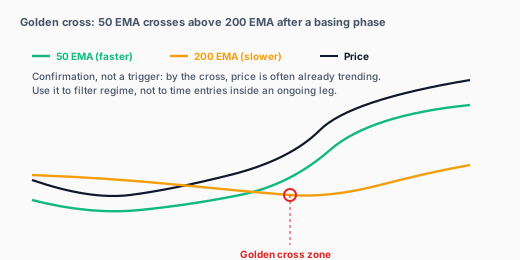
- Treating crosses as entries — they are lagging confirmations, not triggers. Use them to filter universe and define regime.
- Drawing one MA per chart and calling it a system. A single MA without structure or volume context is just a smoothed line.
- Buying "reclaims" of the 200 SMA after a multi-month downtrend on day one. Reclaims need time and tests — not a single green bar.
- Ignoring slope. Flat moving averages mean the stock is in a range; the same chart pattern that worked in trend will whipsaw here.