
RSI for swing traders: regime-aware momentum, not overbought/oversold
Most people use RSI wrong. Here is what the 14-period RSI actually tells you — and the divergence patterns that matter.
~28 min read
The Relative Strength Index (RSI) measures the speed of recent gains versus losses over a lookback (default 14). It outputs a value between 0 and 100. The textbook reading — "above 70 is overbought, below 30 is oversold" — is responsible for more bad trades than almost any other indicator in retail use. Strong trends spend weeks with RSI above 70; weak ones spend weeks below 30. The textbook thresholds are not entries — they are descriptions of how stretched recent momentum is.
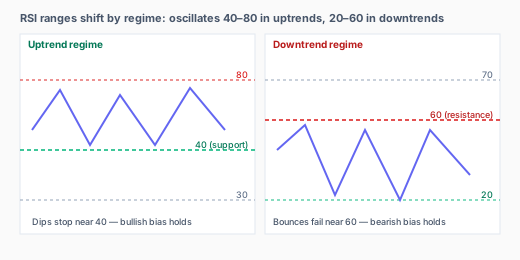
RSI ranges shift by regime
In a healthy uptrend, RSI oscillates roughly between 40 and 80 — dips to 40-50 are buying opportunities for trend-followers and rallies to 70-80 are continuation, not reversal. In a downtrend, the same indicator oscillates between 20 and 60 — bounces to 50-60 are selling opportunities for trend-followers, dips to 20-30 are continuation, not reversal. The same number means different things in different regimes.
Bullish reversal divergence
Bullish divergence: price prints a lower low, but RSI prints a higher low. The new price low is happening with less momentum than the prior one — sellers are losing intensity. This is a setup-quality clue, not an entry. The actionable trade comes when price confirms by breaking a swing high or reclaiming a structural level. Trading divergence alone, with no confirmation, gets you long every falling knife.
Bearish reversal divergence
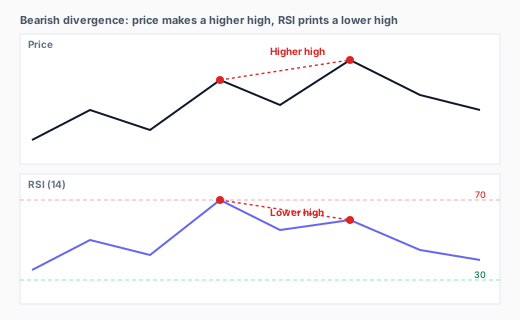
Bearish divergence: price makes a higher high, but RSI makes a lower high. The new high is being made with less momentum. In a mature uptrend near a known resistance, this is a tightening-of-risk signal. In a strong young trend, divergence happens frequently and resolves up — don't short divergence inside Stage-2 leaders without other evidence.
Hidden divergence — continuation pattern
Less famous but more useful for swing traders: hidden bullish divergence. Price prints a higher low, but RSI prints a lower low. This means the pullback was shallow in price but momentum reset deeply — perfect for continuation. The mirror — hidden bearish divergence (lower high in price, higher high in RSI) — flags weakness inside a downtrend bounce, useful for short-side continuation.
Swing failure / failure swings
A swing failure happens when RSI pushes into overbought (70+) or oversold (sub-30), pulls back, and then fails to reach the prior extreme on the next push. For example: RSI hits 78, pulls back to 55, rallies to 71 (lower high inside overbought), and then breaks below 55. That structural break inside RSI itself is a higher-confidence signal than reaching any single absolute level.
Practical RSI rules for swing
- Never enter purely because RSI is at 70 or 30 — these are descriptions, not signals.
- Pullback longs in uptrends: RSI dipping to 40-50 with price near 20/50 EMA is a higher-quality entry than chasing the breakout.
- Divergence is a setup quality multiplier, not a standalone trigger. Always wait for price confirmation.
- Strong leaders spend extended time above 70. Selling a leader because of overbought RSI is a classic way to miss the meat of the move.
- Use a longer RSI period (21 or 25) on weekly charts for regime — short-period RSI on weekly is noise.
RSI failure modes
- Divergence in trending stocks resolves up/down repeatedly before the actual reversal — divergence is a tell, not a clock.
- Strong momentum can keep RSI pinned above 70 for weeks; selling "overbought" exits trends prematurely.
- Choppy stocks generate constant RSI noise. Use RSI on names with clear structure, not random range-bound tickers.
- Adjust period thoughtfully: shorter RSI (7 or 9) for active swings, longer (21+) for position / weekly context.